
Lihat juga


 11.06.2026 04:01 AM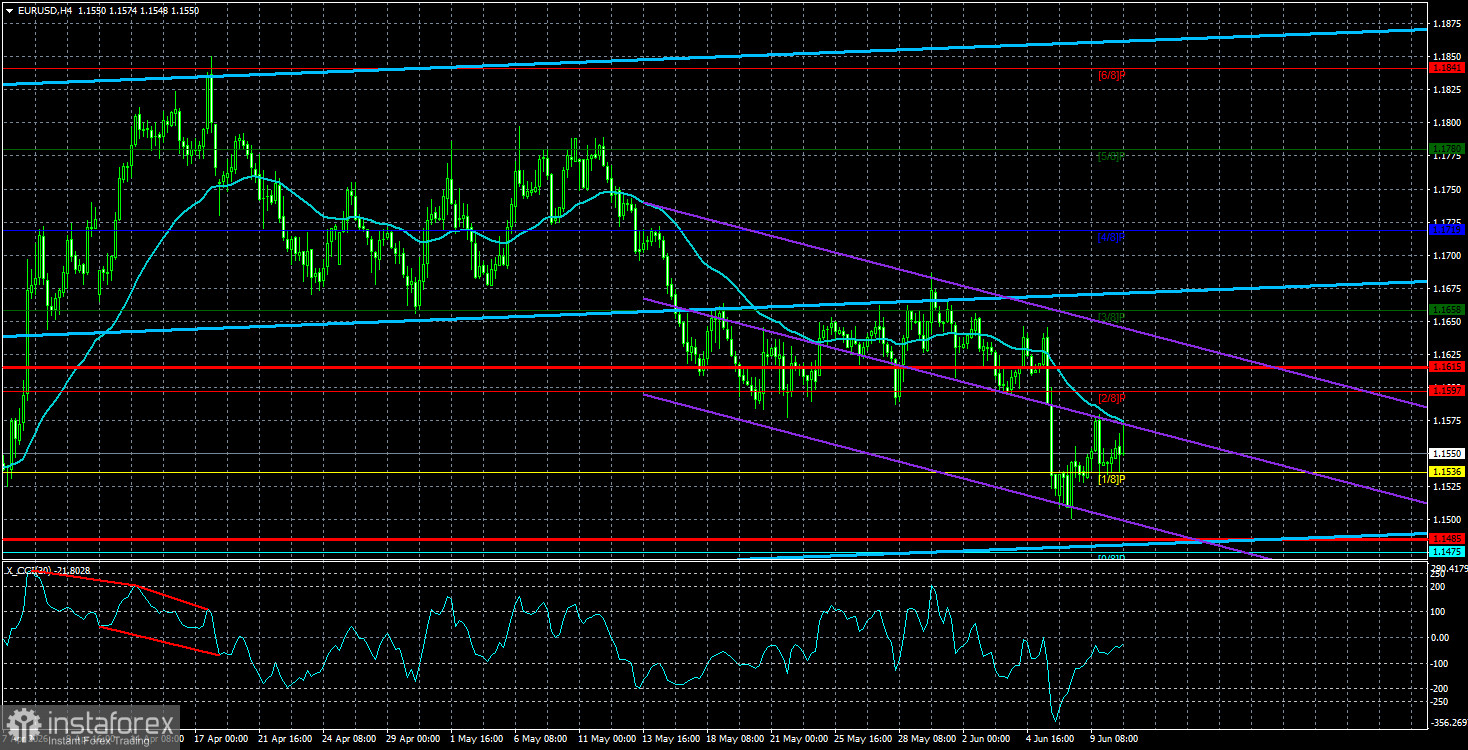
The EUR/USD currency pair maintained a downward bias on Wednesday, with geopolitical events not suggesting otherwise at this time. Recall that the week began optimistically with new promises from Donald Trump to sign an agreement with Iran very soon. However, the next day, something went awry in the American president's plans. It became known that Iran attacked and destroyed an American Apache helicopter patrolling the Strait of Hormuz. In response to this "outrageous act of aggression," the US struck Iranian radars and launch sites. Yesterday, Tehran began launching retaliatory strikes against Bahrain, Kuwait, and Jordan.
As we can see, Donald Trump appears to be living in some parallel universe where a deal with Iran has already been agreed upon, and victory over a principal adversary was achieved months ago. In reality, there is no deal with Iran in sight, and the market is once again starting to wake up from the "noodles" that the White House leader has been dangling before it. Therefore, it is not surprising that the American currency is rising again. It is rising moderately, as the prospect of resuming full-scale war is not on the table either. No one wants it, but Iran is ready for it, while the US is unlikely to be.
As a result, we find ourselves with something between a ceasefire and full-scale war. Military experts probably cannot even describe the current situation with a single term, as such a term simply does not exist. However, there is effectively no ceasefire now, and negotiations have long taken on a formal status. The market continues to ignore all macroeconomic and fundamental backgrounds, so even the European Central Bank's readiness to raise interest rates today does not play any role.
Just think about it: the ECB is ready to tighten monetary policy (the first and only major central bank to do so), yet the euro continues to fall. When will we see this again? It's all because 90% of the dynamics of the currency market and currency instruments are determined by geopolitics. We have been highlighting this for three months straight. Therefore, today it absolutely does not matter what decision the ECB will make (though it is essentially already known), what rhetoric Christine Lagarde will maintain (even if she promises five more rate hikes), or what statements will be made regarding the economy and inflation.
It is evident to all that if the conflict in the Middle East is not resolved, inflation will continue to accelerate, and a single interest rate hike will not extinguish this process. Thus, there is no sense in just tightening policy, and whether the ECB is ready to raise rates multiple times remains a big question, given the European economy's growth rate in the first quarter. However, let us repeat once more: all this information is currently irrelevant. Perhaps the market will react, for formality's sake, to the results of today's meeting and Lagarde's speech. But then everything will revert to the norm. The pair may change direction five times in a day solely based on geopolitical factors.
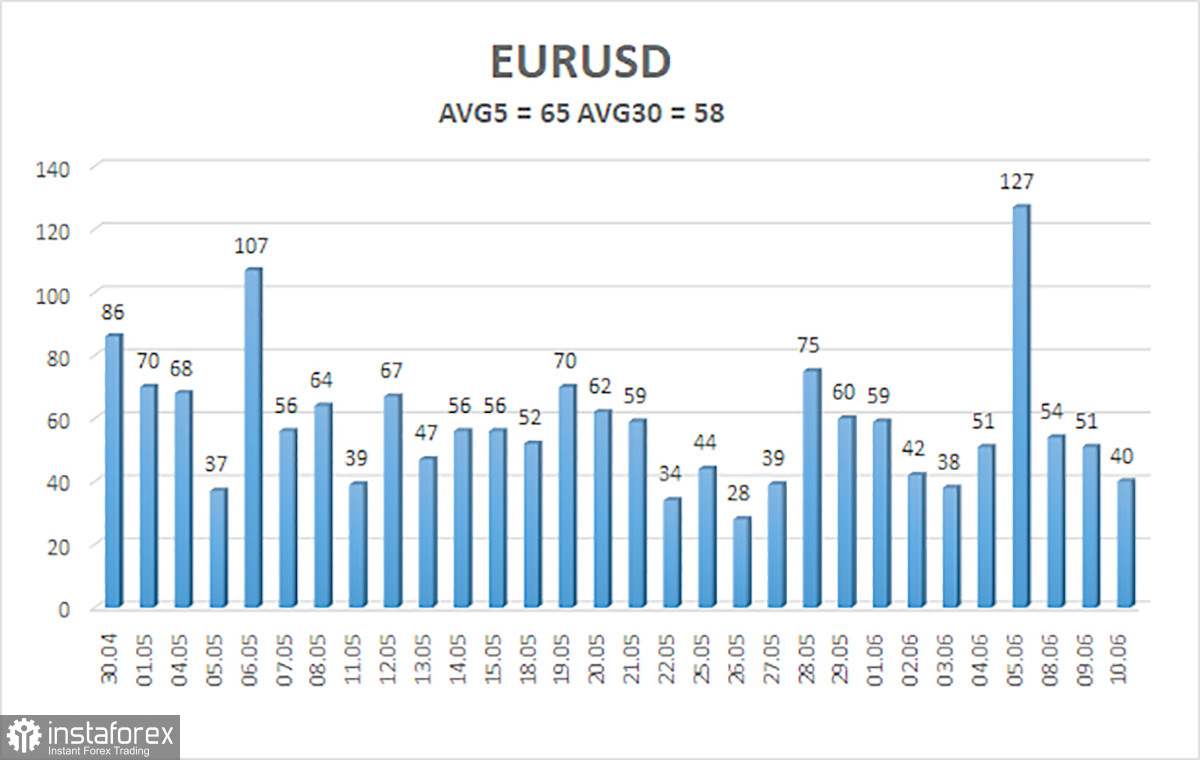
The average volatility of the EUR/USD currency pair over the last five trading days as of June 11 is 65 pips, which is considered "average." We expect the pair to move between levels 1.1485 and 1.1615 on Thursday. The upper channel of the linear regression has turned upwards, indicating a trend change to upward. The CCI indicator has entered the overbought area and formed two bearish divergences, warning of the onset of a downward correction that has not yet completed. On Friday, it entered the oversold area, warning of a possible completion of the correction.
S1 – 1.1536
S2 – 1.1475
S3 – 1.1414
R1 – 1.1597
R2 – 1.1658
R3 – 1.1719
The EUR/USD pair continues its downward movement, which is presumably a correction within the global upward trend. The global fundamental background for the dollar remains extremely negative, and only geopolitical factors regularly provide support to it. When the price is below the moving average, short positions can be considered with targets at 1.1485 and 1.1475. Long positions become relevant when the price is above the moving average line, targeting 1.1719 and 1.1780. The market continues to move away from geopolitical factors, but in recent weeks, the dollar has been in demand as hopes for peace in the Middle East have grown weaker.
Linear regression channels help determine the current trend. If both are pointing in the same direction, it indicates a strong trend.
The moving average line (settings 20,0, smoothed) determines the short-term trend and the direction in which trading should be conducted.
Murray levels are target levels for movements and corrections.
Volatility levels (red lines) indicate a probable price channel, within which the pair will operate for the next day, based on current volatility indicators.
The CCI indicator: its entry into the oversold area (below -250) or the overbought area (above +250) indicates that a trend reversal in the opposite direction is approaching.


