
Vea también


 17.12.2025 01:31 PM
For GBP/USD, the wave count continues to indicate the construction of an upward trend segment (see bottom chart), but over the past few weeks it has taken on a more complex and extended form (see top chart). The trend segment starting on July 1 can be considered wave 4, or any global corrective wave, as it clearly has a corrective rather than impulsive internal wave structure. The same applies to its internal subwaves. The downward wave structure starting on September 17 took on a five-wave form (a–b–c–d–e) and is now complete. The pair is currently in the process of forming a new upward wave sequence.
Of course, any wave structure can become more complex and extended at any moment. Even the assumed wave 4, which has been forming for six months, could take on a five-wave form, in which case we would observe the correction for several more months. However, at this time, the instrument has every chance of forming a bullish wave sequence. If this is indeed the case, the first two waves of this segment are already complete, and we are now observing the construction of wave 3 or c, which appears impulsive and suggests an impulsive character for the current wave sequence.
The GBP/USD rate rose by 70 basis points on Tuesday and has the potential to rise much further. From Tuesday's results, two key conclusions can be drawn:
However, the pound should not be too pessimistic. The market had already expected a new round of easing in December, and Andrew Bailey had mentioned four potential rate cuts earlier this year.
In short (with a more detailed review of economic data to follow), the UK unemployment rate is rising but remains within forecasts. Meanwhile, wage growth is accelerating, which could potentially reignite inflation—something the Bank of England has struggled to control over the past five months. Inflation has fallen for two consecutive months, giving the Bank of England room to continue cutting rates. Similarly, with the latest U.S. labor market data, the Fed can continue easing.
U.S. statistics could fill five full reviews to cover them thoroughly. In short, all labor market and unemployment reports were disappointing. Therefore, any decline in GBP/USD may be very short-lived.
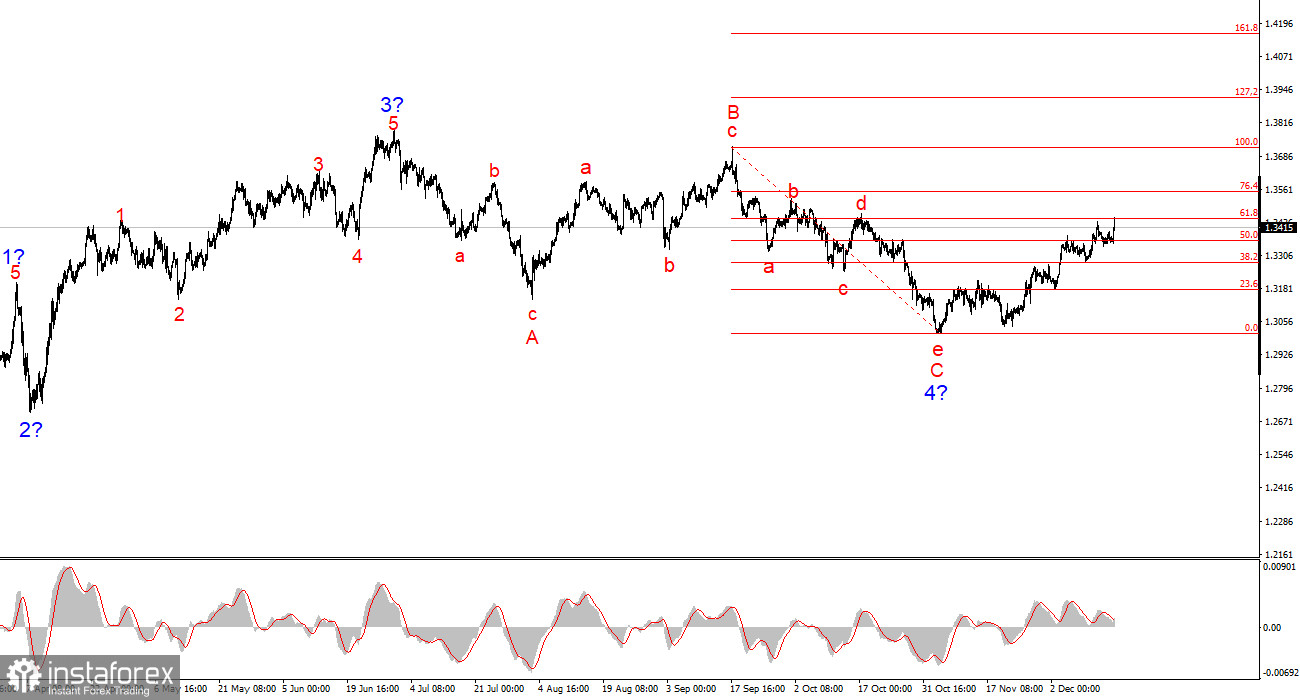
The GBP/USD wave picture has evolved. We are still dealing with an upward, impulsive trend segment, but its internal wave structure has become complex. The downward corrective structure a–b–c–d–e within C of wave 4 is complete, as is the entirety of wave 4. If this is indeed the case, I expect the main trend segment to resume its construction, with initial targets around the 38- and 40-figure levels.
In the short term, I expected the construction of wave 3 or c with targets around 1.3280 and 1.3360, corresponding to 76.4% and 61.8% Fibonacci retracement levels. These targets have been reached. Wave 3 or c continues to form, and the current wave sequence is beginning to take on an impulsive character. Consequently, we can expect a continuation of the upward movement, with targets around 1.3580 and 1.3630.
The wave count on the higher timeframe looks almost perfect, even though wave 4 has slightly surpassed the maximum of wave 1. However, it should be noted that "perfect" wave counts exist only in textbooks; in practice, things are much more complex. At this time, I see no reason to consider alternative scenarios for the bullish trend segment.
Key Principles of My Analysis


