
Veja também


 24.06.2026 03:59 AM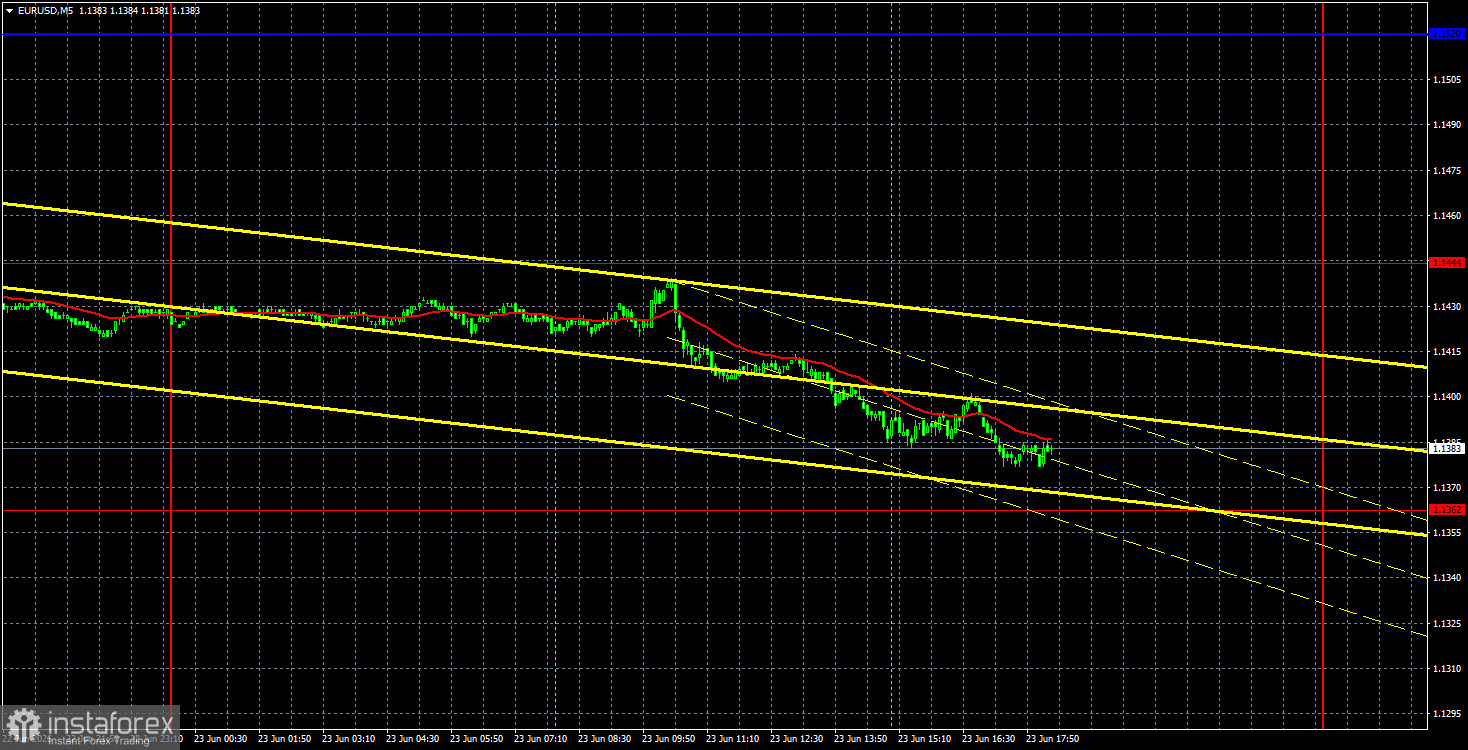
The EUR/USD currency pair continued its downward movement on Tuesday, showing no intent to correct, while most currency analysts continued to write about the impact of the Federal Reserve's upcoming interest rate hike on the dollar's exchange rate. It is quite convenient to claim daily that the dollar rises solely due to the Fed's "hawkish" policies, which, in essence, are not applicable at this time. Recall that the Fed has only made it clear that it is ready to begin tightening monetary policy in 2026 if inflation continues to accelerate and does not begin to decline on its own. The first increase in the key interest rate may not occur earlier than September. And by that time, inflation might begin to slow, which means tightening may not be necessary. Thus, the future increase in the Fed's rates is not predetermined, even as the market buys dollars based solely on this factor, ignoring the European Central Bank's tightening in June and the resolution of the conflict in the Middle East? We consider such a conclusion to be incorrect. There are simply no grounds for the current dollar growth.
From a technical standpoint, the downward trend continues, but while last Wednesday's dollar growth was justified, it has not been so in the following days. Nevertheless, the trend remains downward, so until it ends, short positions are prioritized. A new trend line cannot yet be formed, as there is no second pronounced extreme.
In the 5-minute timeframe, no trading signals were generated on Tuesday. During the European session, the price just barely fell short of reaching the level of 1.1444, and only by the end of the day did the pair drop to 1.1362. Thus, there were no grounds for opening trades during the day. However, traders could remain in short positions from Monday, when two sell signals were formed near the level of 1.1444.
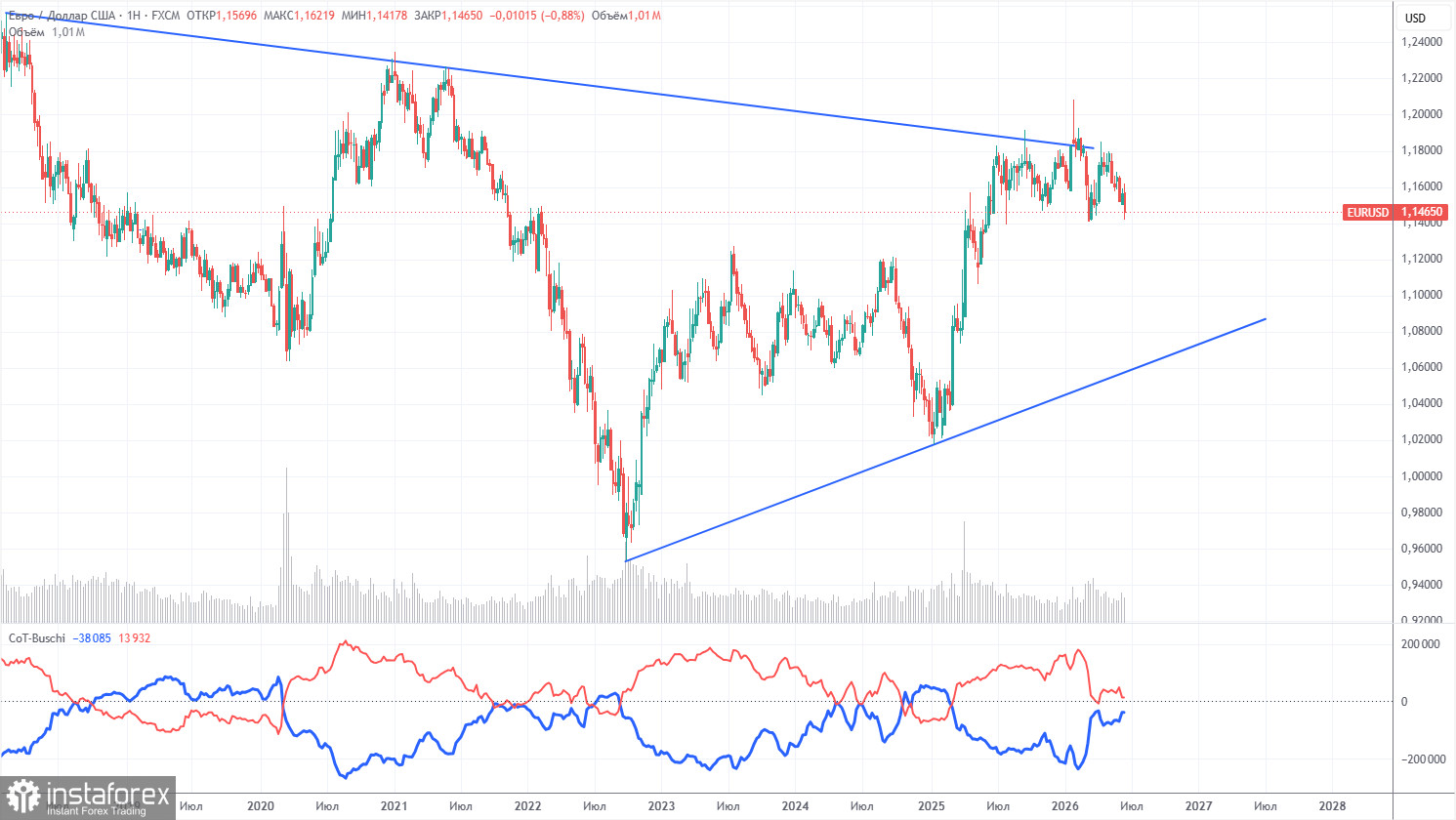
The latest COT report is dated June 9. In the weekly timeframe, the net position of non-commercial traders remains "bullish" but has declined significantly due to geopolitical events. Traders have been offloading the European currency in favor of the US dollar in recent months. Donald Trump's policy has not changed, but the dollar has temporarily served as a "reserve currency." However, this process may have already been completed.
We still do not see any fundamental factors to strengthen the European currency, while there remain sufficient factors for the decline of the American currency. The war in the Middle East has temporarily made the dollar super attractive, but once the "shelf life" of this factor expires, everything will return to the way it was before. And it may have already expired. In the long term, the euro could fall to 1.08$ (the trend line), but the upward trend will remain relevant. And in recent months, the pair has not come significantly closer to this line.
The positioning of the indicator's red and blue lines suggests a balance between bulls and bears. During the last reporting week, the number of longs in the "Non-commercial" group decreased by 15,900, while the number of shorts increased by 19,000. Consequently, the net position fell by 34,900 contracts over the week.
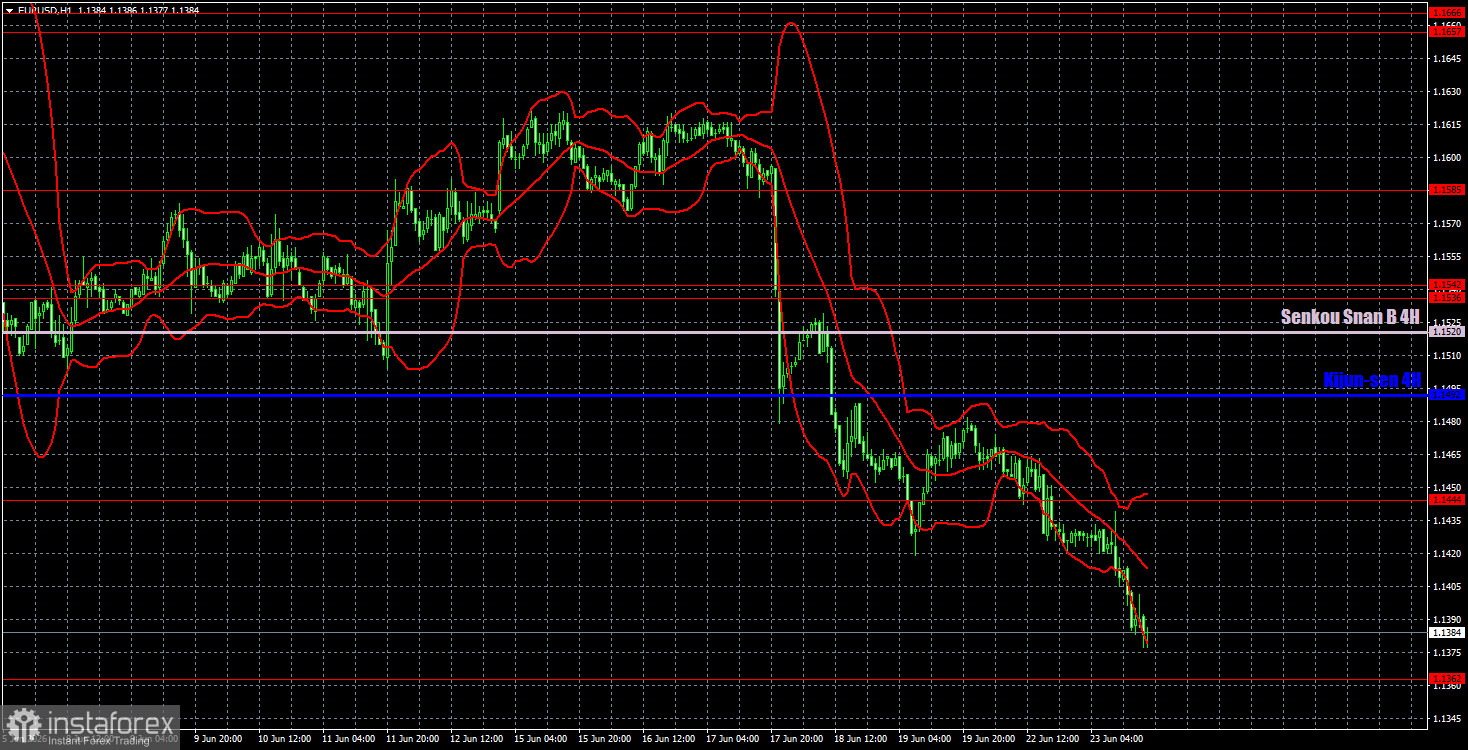
On the hourly timeframe, the upward trend has been canceled, and the continuation of the downward trend is in question. The situation in the Middle East has been resolved, so the dollar can no longer rely on geopolitical support. The Federal Reserve provided strong support to the American currency last Wednesday, but it is difficult to say why the decline continues to this day. The market continues to buy dollars for no reason and ignores all factors in favor of the euro.
On June 24, we highlight the following levels for trading: 1.1362, 1.1444, 1.1536-1.1542, 1.1585, 1.1657-1.1666, 1.1750-1.1760, 1.1786, 1.1830-1.1837, 1.1907-1.1922, as well as the Senkou Span B line (1.1520) and the Kijun-sen line (1.1492). The Ichimoku indicator lines may move during the day, which should be considered when determining trading signals. Don't forget to set a stop-loss order at breakeven once the price has moved in the correct direction by 15 pips. This will protect against potential losses if the signal proves false.
On Wednesday, there are no noteworthy macroeconomic or fundamental events. In Germany, the business climate index will be published, and in the US, the new home sales report will be published. Both reports are completely secondary, so the market is unlikely to react to them.
Today, traders may consider short positions with a target of 1.1274 if the price breaks below 1.1362. Long positions can be opened with a target of 1.1444 if the pair bounces from 1.1362.
Price support and resistance levels are thick red lines near which the movement may end. They are not sources of trading signals.
The Kijun-sen and Senkou Span B lines are Ishimoku indicator lines transferred from the 4-hour timeframe to the hourly timeframe. They are strong lines.
Extreme levels are thin red lines from which the price has previously bounced. They are sources of trading signals.
Yellow lines indicate trend lines, trend channels, and any other technical patterns.
Indicator 1 on the COT charts shows the size of the net position of each category of traders.


