
यह भी देखें


 17.08.2026 12:59 PM
Bitcoin has returned to the $63,500 level. Ethereum has also moved up toward $1,900, preparing to test the $2,000 level again.

A potential catalyst for a breakout from the range could be a shift in expectations regarding the Fed's interest-rate policy, as indicated by Goldman Sachs. The bank recently lowered its estimate of the probability of a September rate hike in response to a series of weak economic data releases, namely retail sales, a key gauge of consumer spending, and employment data.
"According to the baseline economic forecasts, inflation data are more likely to improve than to deteriorate again," the report stated. "We still believe that market pricing for the federal funds rate is too hawkish."
As a reminder, the importance of interest rates for cryptocurrencies can be explained by liquidity dynamics. Interest rates determine the availability of credit and fiat liquidity throughout the economy, directly affecting demand for risk assets such as Bitcoin. Higher interest rates are traditionally a bearish factor, as was clearly demonstrated during the Fed's aggressive tightening cycle, which triggered the 2022 market collapse. Lower rates, by contrast, are viewed as a bullish signal, as demonstrated by the cryptocurrency rally following the March 2020 market crash.
According to the CME FedWatch Tool, traders assess the probability of a 25-basis-point Fed rate hike to the 3.75%–4.00% range at just 30.6%, while most expect the status quo to be maintained.
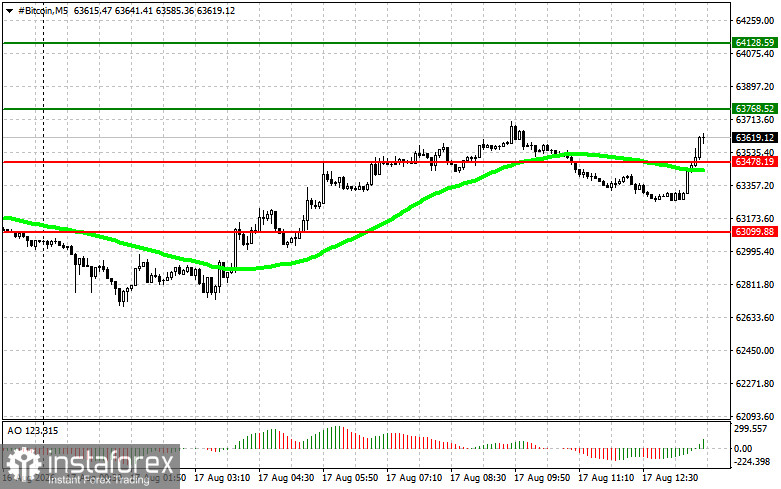
Scenario #1: Today, I will buy Bitcoin when the entry point is reached around $63,700, with a target of $64,100. Around $64,100, I will close the long position and immediately look to sell on a rebound. Before buying on a breakout, make sure that the 50-day moving average is below the current price and that the Awesome Oscillator is above zero.
Scenario #2: Bitcoin can be bought from the lower boundary at $63,500 if there is no market reaction to a break below this level and the price returns toward $63,700 and $64,100.
Scenario #1: Today, I will sell Bitcoin when the entry point is reached around $63,500, with a target of $63,100. Around $63,100, I will close the short position and immediately look to buy on a rebound. Before selling on a breakout, make sure that the 50-day moving average is above the current price and that the Awesome Oscillator is below zero.
Scenario #2: Bitcoin can be sold from the upper boundary at $63,700 if there is no market reaction to a break above this level and the price returns toward $63,500 and $63,100.
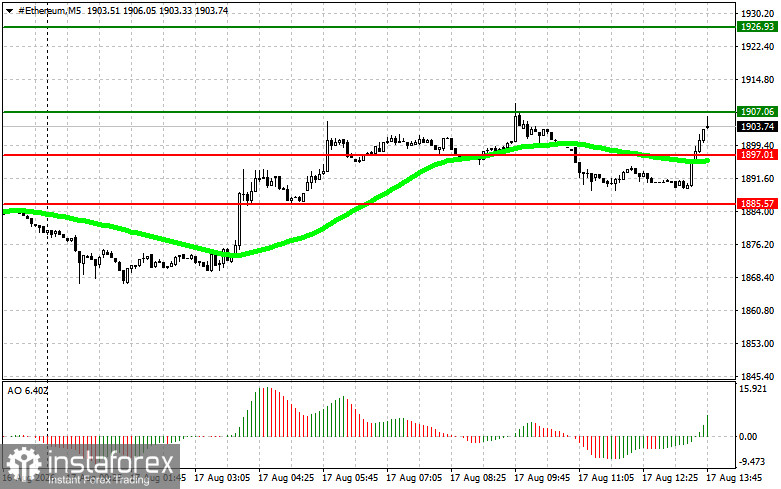
Scenario #1: Today, I will buy Ethereum when the entry point is reached around $1,907, with a target of $1,926. Around $1,926, I will close the long position and immediately look to sell on a rebound. Before buying on a breakout, make sure that the 50-day moving average is below the current price and that the Awesome Oscillator is above zero.
Scenario #2: Ethereum can be bought from the lower boundary at $1,897 if there is no market reaction to a break below this level and the price returns toward $1,907 and $1,926.
Scenario #1: Today, I will sell Ethereum when the entry point is reached around $1,897, with a target of $1,885. Around $1,885, I will close the short position and immediately look to buy on a rebound. Before selling on a breakout, make sure that the 50-day moving average is above the current price and that the Awesome Oscillator is below zero.
Scenario #2: Ethereum can be sold from the upper boundary at $1,907 if there is no market reaction to a break above this level and the price returns toward $1,897 and $1,885.

