
यह भी देखें


 06.08.2026 08:41 AM
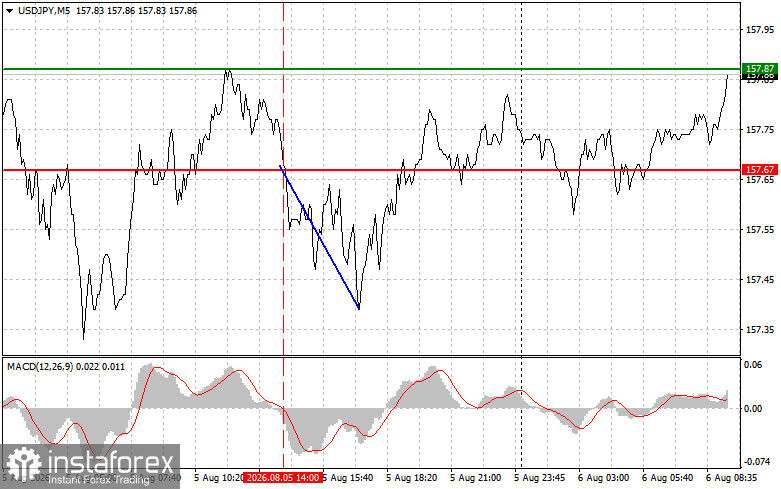
The price test at 157.67 occurred when the MACD indicator had just begun to move downward from the zero mark, confirming the correct entry point to sell the dollar. As a result, the pair fell by almost 30 pips.
Yesterday's data from the US put pressure on the dollar and led to a slight strengthening of the yen; however, trading remained within a sideways channel. After such major currency interventions, market participants are wary of taking serious actions. Today, Japan's Prime Minister Sanae Takaichi promised to restore the 8% sales tax on food two years after its temporary reduction to 1%, calling it a commitment. The problem is that she currently lacks a clear plan to finance the expected budget deficit of over 4 trillion yen per year, and analysts doubt that the promised return of the rate will actually occur, given that previous increases in this tax have typically been postponed due to their impact on the economy. For the yen, this is a moderately negative but likely gradual factor: unclear financing for the tax reduction heightens concerns about Japan's fiscal discipline and the risk of rising government bond yields, which traditionally pressures the currency; however, a sharp shock is not expected since the soft fiscal stance of Takaichi's government has long been priced into market expectations.
As for the intraday strategy, I will rely mainly on implementing Scenarios No. 1 and No. 2.
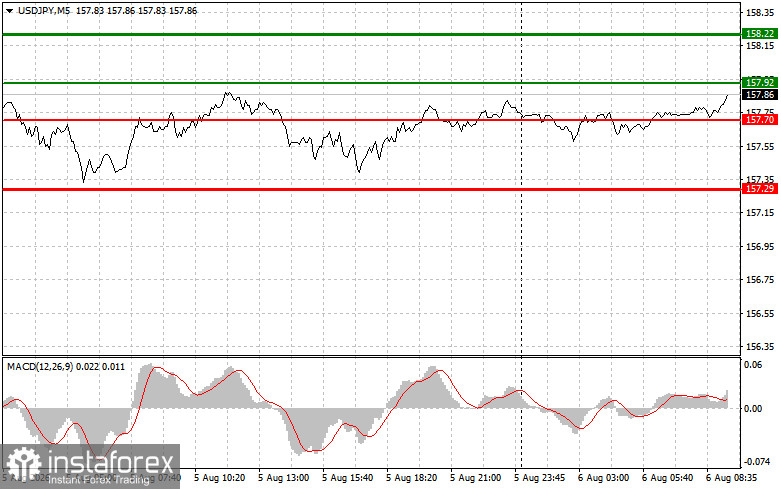
Scenario No. 1: I plan to buy USD/JPY today at the entry point around 157.92 (green line on the chart), with a target of 158.22 (thicker green line on the chart). Around 158.22, I intend to exit long positions and open short positions in the opposite direction (expecting a 30–35 pip move in the opposite direction from that level). It is best to return to buying the pair on corrections and significant dips in USD/JPY. Important! Before buying, make sure the MACD indicator is above the zero mark and is just starting its rise from it.
Scenario No. 2: I also plan to buy USD/JPY today in the event of two consecutive tests of the 157.70 price when the MACD indicator is in the oversold area. This will limit the pair's downside potential and lead to a reversal of the market upward. One can expect a rise to the corresponding levels of 157.92 and 158.22.
Scenario No. 1: I plan to sell USD/JPY today only after a break of the 157.70 level (red line on the chart), which will lead to a rapid decline in the pair. The sellers' key target will be 157.29, where I plan to exit shorts and immediately open longs in the opposite direction (expecting a 20–25 pip move in the opposite direction from that level). Sellers will return at any moment; it just takes any hint from the central bank. Important! Before selling, make sure the MACD indicator is below the zero mark and is just beginning its decline from it.
Scenario No. 2: I also plan to sell USD/JPY today if there are two consecutive tests of 157.92 while the MACD is in the overbought area. This will limit the pair's upside potential and lead to a downward reversal in the market. One can expect a decline to the corresponding levels of 157.70 and 157.29.
Important: Beginner forex traders need to make entry decisions very cautiously. Before key fundamental reports are released, it is best to stay out of the market to avoid sharp price fluctuations. If you decide to trade during news releases, always set stop orders to minimize losses. Without placing stop orders, you can quickly lose your entire deposit, especially if you do not practice money management and trade large volumes.
And remember, successful trading requires a clear trading plan, as outlined above. Making spontaneous trading decisions based on the current market situation is inherently a losing strategy for intraday traders.

