
यह भी देखें


 01.04.2026 04:01 AM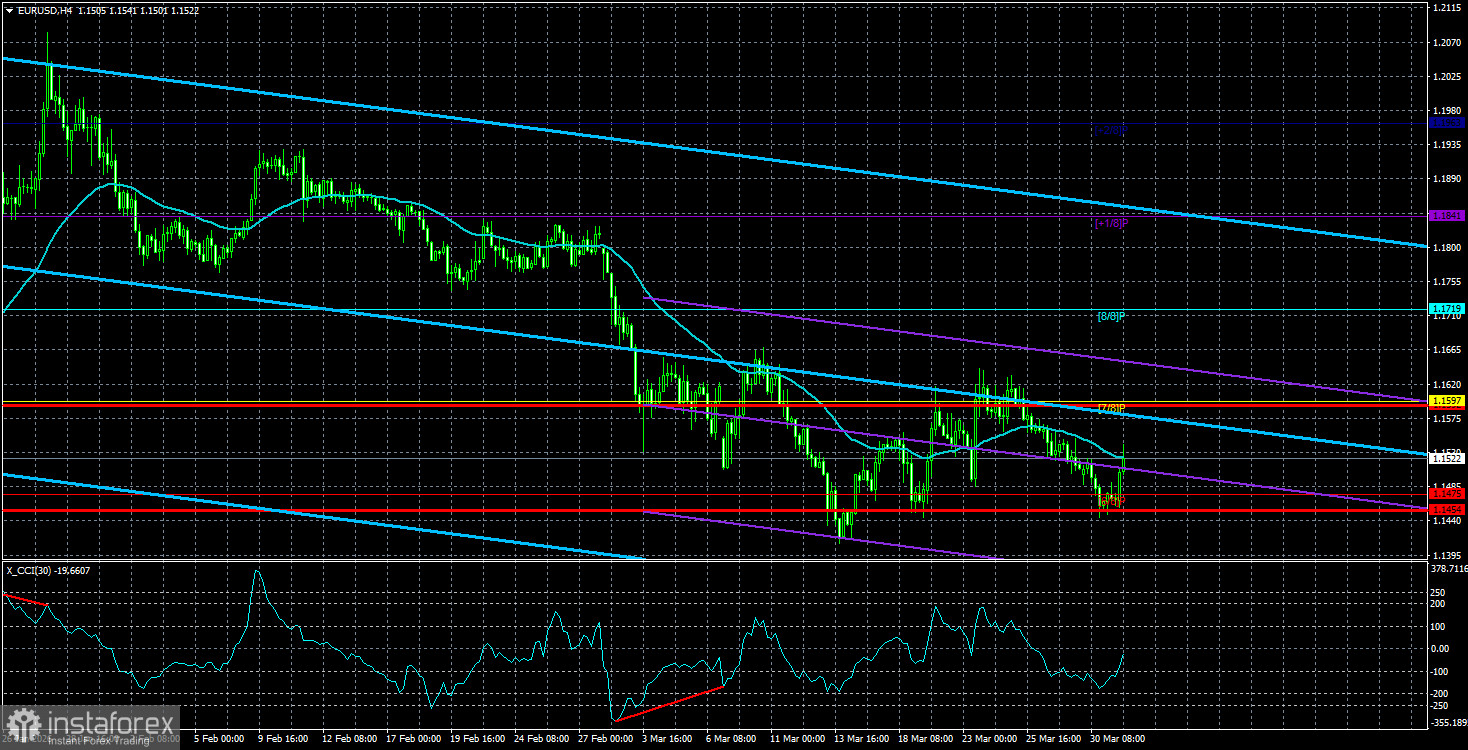
The EUR/USD currency pair unexpectedly began to rise on Tuesday. This event seems like a miracle considering that oil prices continue to soar. If oil prices are rising, it means the market is expecting deteriorating conditions in the Middle East and an increasing global shortage of "black gold." Thus, a new rise of the US currency would have been much more logical. However, perhaps the market has finally become saturated with dollar purchases?
Let's remember that conflicts of various scales flare up around the world regularly. For example, the war in Ukraine has been ongoing for 5 years, and the dollar initially rose sharply due to this event. However, sooner or later, geopolitics gets forgotten or takes a back seat. The market simply cannot constantly react only to geopolitics, and military conflicts around the world do not end. Therefore, we have long said: the dollar can rise to almost any value, but when the geopolitical factor becomes tiresome for the markets, it will resume its decline.
On the higher time frames, it is clear that the uptrend is still intact, despite the pair's 650-point decline over the past two months. This is evident even on the daily chart, where, for example, the local low from August 1 of last year has not been broken. The four-year uptrend is even more evident on the weekly chart. If the dollar has been falling for four years now, with no support from fundamentals, macroeconomics, or the U.S. president, can a single geopolitical event (even one like the situation in the Middle East) completely reverse the long-term trend? In our view, no. We are not claiming that yesterday's downward move has ended 100%, but at the same time, the dollar has been rising recently, almost exclusively on geopolitics. All other factors have been ignored. You have to agree that this cannot last forever.
By the way, yesterday a fairly important inflation report for March was published in the Eurozone. The Consumer Price Index rose to 2.5% year-over-year, slightly below expectations. Thus, a more predictable market reaction would be a decline of the euro. After all, the lower the inflation, the less likely the ECB is to tighten monetary policy. However, on Tuesday, we saw once again that the market pays little attention to the macroeconomic background. Some experts might write that inflation has still accelerated significantly, but let's remember that the market anticipates these forecasts in advance. Therefore, it is prepared in advance for them. Traders react to the relationship between actual and forecast values.
In the current situation, the pair could even begin a rise that is at least as strong as the preceding decline. If geopolitics no longer interests currency traders, it means the dollar is losing its only growth factor. In this case, it may resume its free fall off a cliff that began with Trump's second term. Remember that the American president does not want a strong dollar, as it further reduces the likelihood of achieving a positive trade balance for the US.
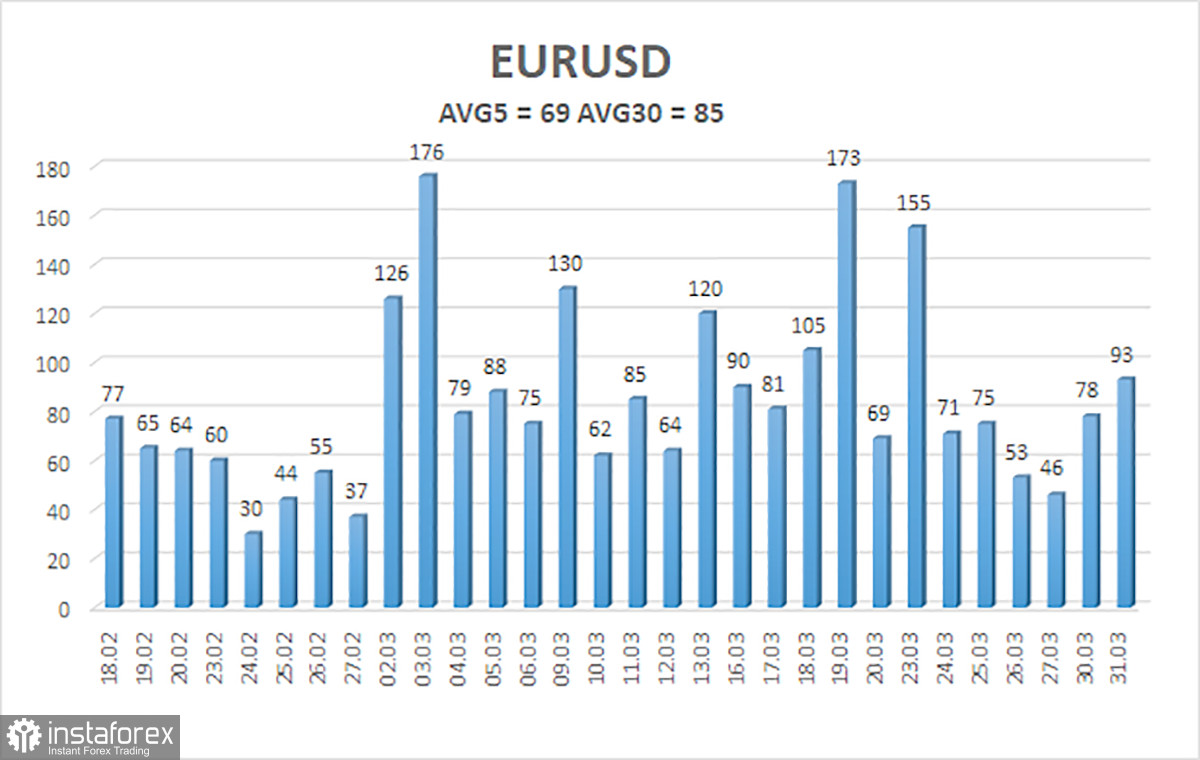
The average volatility of the EUR/USD pair over the past five trading days as of April 1 is 69 pips, which is considered "average." We expect the pair to trade between 1.1454 and 1.1592 on Wednesday. The upper channel of the linear regression has turned downward, indicating a trend change. The CCI indicator has entered the oversold area and formed a "bullish" divergence, which once again warns of the completion of the downward trend. However, geopolitics continues to weigh on the pair.
The EUR/USD pair continues its downward movement, driven by geopolitical factors. The global fundamental backdrop for the dollar remains extremely negative; however, for over a month, the market has been paying attention solely to geopolitics, rendering all other factors virtually irrelevant. When the price is below the moving average, short positions can be considered with targets at 1.1454 and 1.1353. Above the moving average line, long positions remain relevant with a target of 1.1719. For a stronger upward movement, the geopolitical backdrop must at least start to improve.

