
यह भी देखें


 15.12.2025 11:57 AM
The U.S. dollar continues to face difficulties that are entirely related to the Federal Reserve's dovish stance at the end of this year. However, not all of its representatives share this approach.
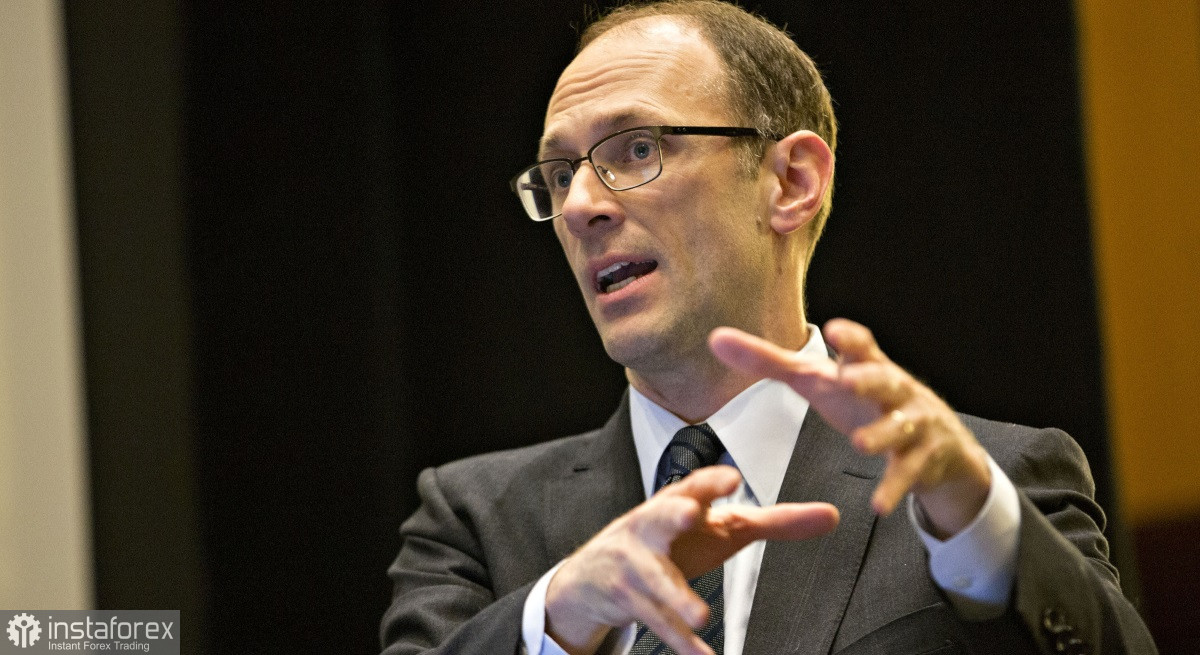
Chicago Federal Reserve Bank President Austan Goolsbee said late last week that he expects more interest rate cuts in 2026 than many of his colleagues, but expressed disagreement with a possible rate cut in December, as he would like to wait for additional inflation data.
"I am not hawkish on interest rates for next year," Goolsbee said on Friday. "I'm one of the more optimistic people about how much rates could come down next year."
Such statements, even if they still sound isolated for now, add an element of uncertainty to financial markets. Investors, who are accustomed to more or less consistent Fed rhetoric, are now forced to factor in the possibility of disagreements within the regulator. This undoubtedly puts pressure on the dollar, since a unified policy is always perceived by the market as a sign of stability and predictability. The overall macroeconomic situation in the United States also plays a role. At present, unemployment indicators require much closer attention than inflation. And although the Fed is doing everything it can to convince the market that it has the situation under control, each new consumer price index report is met with heightened attention and often triggers volatility in the currency market.
Let me remind you that important reports on the U.S. labor market and inflation will be published this week, which had not been released for quite some time due to the government shutdown.
Comments from the head of the Chicago Fed came immediately after his vote against an interest rate cut on Wednesday, marking his first dissent since assuming the role of central bank president in 2023. This dissent coincided with the position of Kansas City Fed President Jeff Schmid, who also voted against the previous rate cut in October and likewise expressed disagreement with last week's decision.
"Given that inflation has been above our target for four and a half years, and that further progress has stalled for several months, I felt it was more prudent to wait for additional information. Almost all business owners and consumers we have spoken with recently cite prices as their main concern," his statement said.
Philadelphia Federal Reserve Bank President Anna Paulson took a more dovish stance on Friday, saying she remains more concerned about weakness in the labor market than about the risks of rising inflation. Her counterpart, Cleveland Fed President Beth Hammack, by contrast, said she would prefer somewhat tighter interest rates to further pressure inflation, which remains too high.
In his statement, Goolsbee also noted that inflation data received before the government shutdown in October and November reinforced his concerns about cutting interest rates in the near future. "Before the data stopped coming in, there were some worrying indicators," Goolsbee said. "Fortunately, over the next few months we will receive important information about these risks, and hopefully this will allow us to say with confidence that we are on a path back to 2% inflation."
As for the current technical picture in EUR/USD, buyers now need to think about how to take the 1.1750 level. Only this will allow them to target a test of 1.1780. From there, it would be possible to climb to 1.1820, but doing so without support from major players will be quite difficult. The furthest target would be the high at 1.1855. In the event of a decline in the trading instrument, I expect any serious action from large buyers only around the 1.1715 level. If there is no activity there, it would be advisable to wait for a retest of the low at 1.1685 or to open long positions from 1.1650.
As for the current technical picture in GBP/USD, pound buyers need to take the nearest resistance at 1.3375. Only this will allow them to target 1.3405, above which a breakout will be quite difficult. The furthest target would be the 1.3434 level. In the event of a decline in the pair, bears will try to take control of 1.3340. If they succeed, a break of this range will deal a serious blow to bullish positions and push GBP/USD toward the low at 1.3320, with the prospect of a move to 1.3285.

